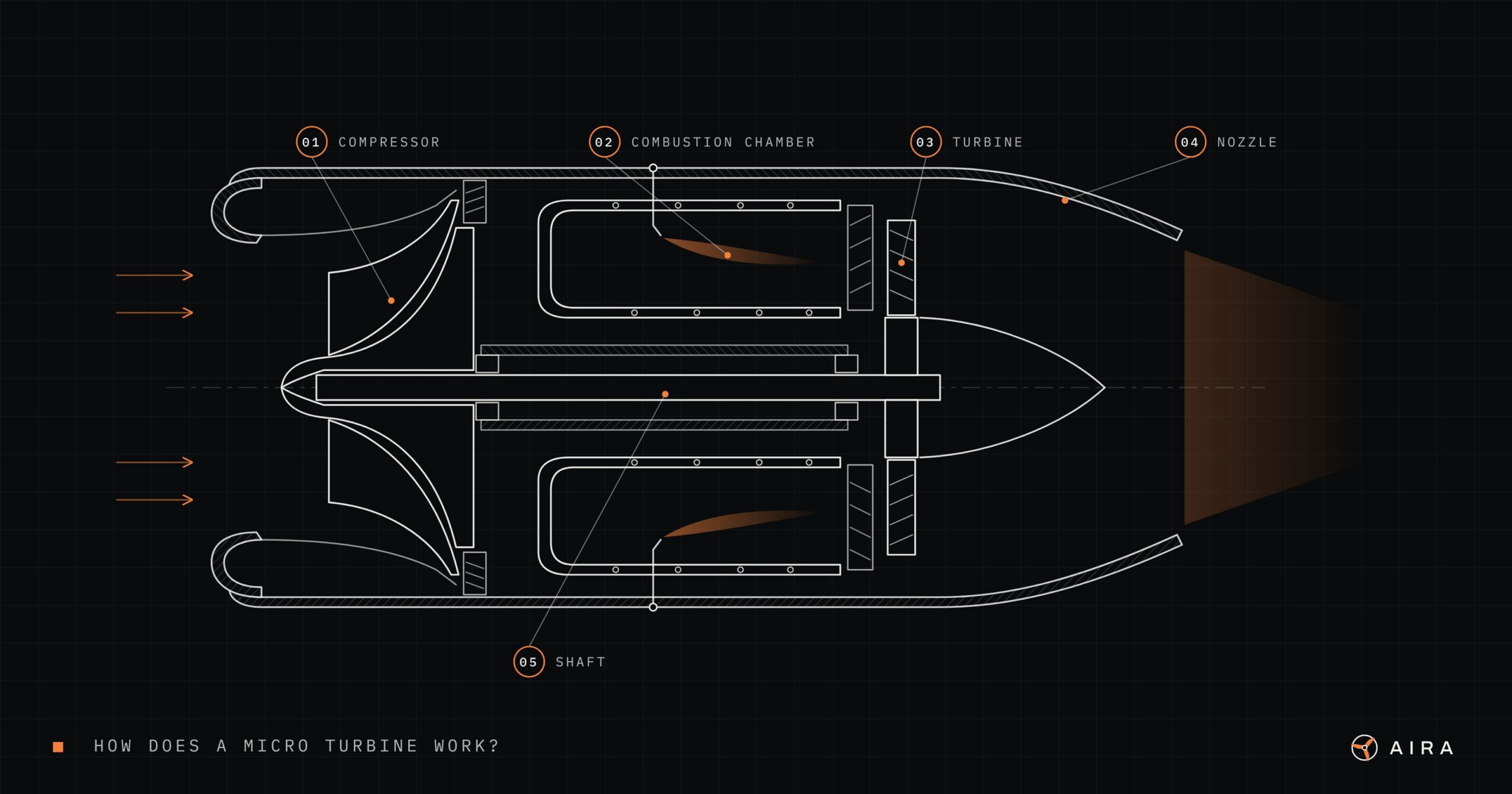
A micro turbine is a small jet engine, usually light enough to pick up with one hand. Inside, it works in the same basic way as the engines on an airliner, with a fraction of the parts. Air comes in at the front and gets compressed, fuel is burned in it, and the hot gas goes out of the back much faster than the air came in. The thrust comes from that difference in speed.
It all happens continuously. A car engine works in strokes, but in a turbine the air is going in, the fuel is burning and the gas is coming out for as long as the engine runs.
The compressor
The first thing the air meets is the compressor. If you have seen the compressor wheel of an F1 turbo you will recognise it: a single wheel with curved blades. An F1 turbo spins at around 100,000 rpm at full boost, and the shaft in an engine this size turns at a similar speed, roughly 1,700 revolutions every second. It pulls air in at the centre and throws it outwards into a ring of fixed vanes, which slow it down and raise its pressure.

The combustion chamber
From there the air goes into the combustion chamber, a ring-shaped space that wraps around the shaft. Fuel is sprayed in and burns continuously. Most small turbines run on kerosene, the same Jet A-1 that airliners use. Less than half of the air is needed to burn the fuel. The rest comes in through holes further along the chamber, where it keeps the walls cool and brings the gas down to a temperature the turbine can stand.

The turbine
The only way out for the gas is through the turbine, a second wheel on the same shaft as the compressor. The gas turns the turbine and the turbine turns the compressor, so the engine supplies its own air. The turbine takes just enough energy out of the gas to do that. It has the hardest job in the engine, spinning at full speed in gas that is still at several hundred degrees.

The nozzle
Whatever energy is left in the gas after the turbine is turned into speed. The nozzle narrows towards the back, the gas accelerates through it, and it can leave at more than 1,000 mph. The engine pushes the gas backwards and the gas pushes the engine forwards, which is the thrust.

One shaft
The compressor, the shaft and the turbine are fixed together and turn as one piece. It is the only major moving part in the engine. There are no pistons, valves or crankshaft, which is why a turbine runs so smoothly and is so small for the thrust it makes. None of that makes one easy to build. That piece is turning around 1,700 times a second with a flame a few centimetres away, and everything in the engine has to be made very accurately.

Where they are used
Micro turbines are used in uncrewed aircraft, target drones and large model jets. The AIR300 is our 300 N-class turbojet for uncrewed aircraft, built in Bicester. If you would like to know more about it, get in touch.
Alex AdamouCo-Founder and Director of R&D, Aira Technology